
Surprising fact: a single login path can change what you can do on an exchange. On OKX, the difference between a logged-in guest, a fully verified account, and a self-custodial Web3 wallet is not cosmetic — it determines custody, regulatory permissions, access to products, and the surface area for certain risks. For U.S.-based traders who care about speed, compliance, and control, that split matters more than which token is hot this week.
This explainer walks through the practical mechanics of OKX verification (KYC), the platform’s Web3 surfaces, and the trade-offs you face when you authenticate and interact. I’ll show how the system is built, why specific login choices change what you can access, where the security and regulatory limits are, and what signals to watch if you want to keep trading without unexpected friction.
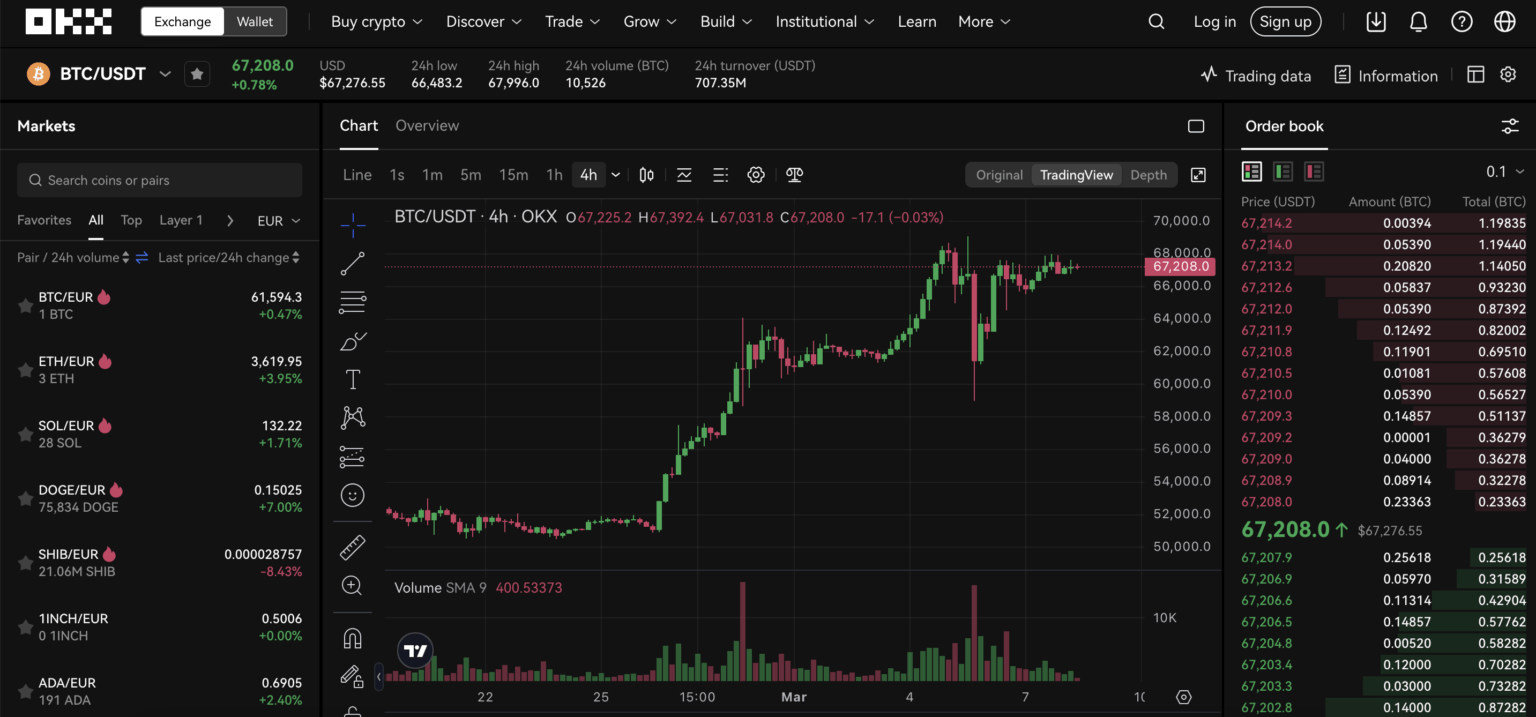
How OKX verification works in practice (mechanisms and consequences)
Mechanically, OKX uses a tiered identity verification process: initial account creation requires basic details; to lift withdrawal and higher-fee limits you must complete Know Your Customer (KYC) checks — a government-issued ID and a facial-recognition liveness step. For U.S. users this is not optional in most cases: AML laws make exchanges require identification before enabling the full suite of services. The immediate consequence is simple: unverified or partially verified accounts face caps on deposit/withdrawal sizes, restricted product access, and often inability to use margin or derivatives.
Why those steps matter beyond compliance: verification is the gate that lets the exchange map legal risk to product permissioning. Once verified, the account can access spot, margin up to platform limits, staking, and derivatives (subject to jurisdictional allowances). But verification also increases your exposure to platform-held custody. If you keep assets on OKX after KYC, your counterparty risk is concentrated: the exchange protects assets with cold storage and multi-signature approvals (OKX reports storing over 95% of assets offline), but custodial solutions carry different failure modes than self-custody.
In short: KYC unlocks capability but narrows the security model to whatever the exchange provides and enforces. The trade-off is access versus control.
OKX Web3: non-custodial wallet, DEX aggregator, and where login fits
OKX is not only a centralized exchange (CEX); it bundles a non-custodial Web3 wallet that you control via a seed phrase and integrates a DEX aggregator to source liquidity across chains. Practically this means you can trade two ways: log into the central account (custodial) or connect a self-custodial wallet (non-custodial) to interact with DApps and the DEX. The Web3 wallet supports hardware devices like Ledger and Trezor, which materially reduces the risk of remote key exfiltration compared with a hot wallet.
Operationally, the login and connection choices change both permissioning and risk profile. If you connect a Web3 wallet to OKX’s browser extension or mobile app, you retain private key control — no KYC required for on-chain swaps — but you also assume direct smart-contract and phishing risks. Conversely, a logged-in OKX user who stores funds on the exchange trades smart-contract risk for counterparty risk and the protections of cold storage and Proof of Reserves (OKX publishes on-chain PoR statements enabling users to verify backing ratios).
One practical rule: treat custody and verification as part of your trade plan. If you want rapid access to advanced derivatives and fiat rails from the U.S., KYC is unavoidable. If you want maximum control and to interact permissionlessly with DeFi, the non-custodial wallet is the right surface — but it requires disciplined key management.
Login security and friction: what the mechanisms mean for traders
OKX employs military-grade encryption, AI-driven threat detection, and mandatory two-factor authentication (2FA) for logins. These are meaningful defenses: 2FA reduces account-takeover risk substantially, and the AI systems can flag anomalous access that would otherwise go unnoticed. On mobile, biometric login speeds access while reducing reliance on SMS 2FA, which is vulnerable to SIM swap attacks prevalent in the U.S. market.
Yet no system is perfect. The limits are structural: phishing remains the most common vector that bypasses technical defenses because it exploits human trust. For Web3 interactions, permanent loss from mismanaged seed phrases is another hard boundary — there is no tech fix for a lost seed. For custody on the exchange, while cold storage and multi-signature withdrawals reduce the probability of a mass theft, they do not eliminate operational risk, governance errors, or legal seizure in adversarial scenarios.
Therefore, combine procedural controls (unique passwords, hardware 2FA, anti-phishing codes) with mental rules: never paste your seed phrase into a website, and treat any out-of-band request for your credentials as hostile. Those habits are as important as the exchange’s technical engineering.
What access to products looks like after verification
Once you complete verification on OKX, the platform often enables: spot and margin trading (with up to 10x margin in isolated or cross modes), derivatives including futures and options (leverage up to platform-specified caps like 125x for some perpetuals, depending on asset and jurisdiction), staking and yield-generation products (flexible and fixed-term staking plus DeFi yield farming and auto-compounding), and the NFT marketplace. The catch: some products are region-restricted by law or internal policy; U.S. traders may find certain derivatives or token listings limited compared with other jurisdictions.
Also note product risk differences. Staking and yield products offer passive income but expose you to validator slashing, lock-up periods, and counterparty risks when the staking is managed by the platform. Margin and derivatives amplify returns but also magnify losses and can trigger forced liquidations in volatile markets — a frequent practical hazard around low-liquidity tokens, which is why OKX periodically delists weak pairs (for example, recent delisting of several small spot pairs is part of routine liquidity maintenance).
Decision framework: choosing login mode for a trading objective
Here is a short heuristic I use with traders in the U.S. to choose a login/custody path:
– Liquidity and speed (day trading, quick fiat on/off ramps): prefer a verified custodial account. Expect stronger fiat rails, faster order execution, and access to margin/derivatives, but accept counterparty risk.
– Long-term custody of selective assets + DeFi interactions: favor the non-custodial OKX Web3 wallet or hardware wallet with the exchange as a gateway. You keep keys and reduce central failure points, but you trade convenience and on-exchange product breadth.
– Mixed strategy: use both — keep capital you actively trade in the custodial account and move reserve capital to a self-custodial wallet. This adds operational overhead but splits risk profiles.
Where the system breaks and what to watch next
Two boundary conditions matter. First, regulatory change. U.S. policy developments on stablecoins, KYC for on-chain transactions, or derivatives rules could change which products are available to U.S. users and how onerous verification becomes. Second, market liquidity. Exchanges routinely delist low-volume pairs to protect users from extreme spreads and poor execution; those maintenance choices change the available trading universe and can disrupt strategies built around niche tokens.
Signals to monitor: updates to OKX’s Proof of Reserves publication, any changes to KYC flows or liveness-check tech, and exchange announcements about delistings or product suspensions. These are reliable leading indicators of how usable the platform will be for a given strategy.
For a practical next step, traders should compare the exchange login path with the non-custodial flow before funding significant capital. If you want the official login entry point and step-by-step flow, the OKX web gateway is a useful reference: okx.
FAQ
Do U.S. users have to complete full KYC to trade on OKX?
Yes for most full-featured services. Basic account setup can be quick, but to raise withdrawal limits, use fiat on/off ramps, and access margin or derivatives you will be asked for government ID and a facial liveness check. Expect this to be the norm because of AML obligations.
Is the OKX Web3 wallet safer than keeping funds on the exchange?
“Safer” depends on the risk you worry most about. Self-custody removes counterparty and exchange insolvency risk, but it places the entire burden of key security on you; losing a seed phrase is permanent. Exchange custody centralizes security (cold storage, multisig) and operational protections, but increases exposure to platform-level failures. A hybrid approach balances both.
What login protections should I enable immediately?
Enable strong, unique passwords; hardware 2FA (or an authenticator app) rather than SMS where available; anti-phishing codes if the exchange offers them; and biometric locks on your mobile device. For Web3 wallets, use hardware wallets for large balances and never disclose your seed phrase.
How do delistings affect my trading strategy?
Delistings remove liquidity for certain pairs and can strand positions if you hold tokens that become hard to convert on-exchange. They are a liquidity-maintenance tool; monitor exchange announcements and avoid building core strategies around very low-volume tokens unless you accept exit risk.
Closing takeaway: how you log in to OKX is a strategic choice, not a mere convenience. Verification grants access and regulatory compliance but shifts your security model toward the exchange. The Web3 wallet preserves self-sovereignty but demands disciplined key management. Treat the login decision as part of portfolio design: match custody, verification, and product access to the liquidity needs and risk tolerances of your trading plan, and watch regulatory and liquidity signals that can change that calculus.