hacklink hack forum hacklink film izle hacklink สล็อตเว็บตรงสล็อตbets10sahabetmeritkinghttps://jleak.sa.com/jojobetjojobetjojobet girişdeneme bonusu veren sitelerjojobetjojobet girişpadişahbetjojobetbetciodeneme bonusu veren sitelerjojobet

Software Solutions

Categories
Uncategorized

OKX explained: how verification, Web3, and platform mechanics shape your login and trading choices

Surprising fact: a single login path can change what you can do on an exchange. On OKX, the difference between a logged-in guest, a fully verified account, and a self-custodial Web3 wallet is not cosmetic — it determines custody, regulatory permissions, access to products, and the surface area for certain risks. For U.S.-based traders who care about speed, compliance, and control, that split matters more than which token is hot this week.

This explainer walks through the practical mechanics of OKX verification (KYC), the platform’s Web3 surfaces, and the trade-offs you face when you authenticate and interact. I’ll show how the system is built, why specific login choices change what you can access, where the security and regulatory limits are, and what signals to watch if you want to keep trading without unexpected friction.

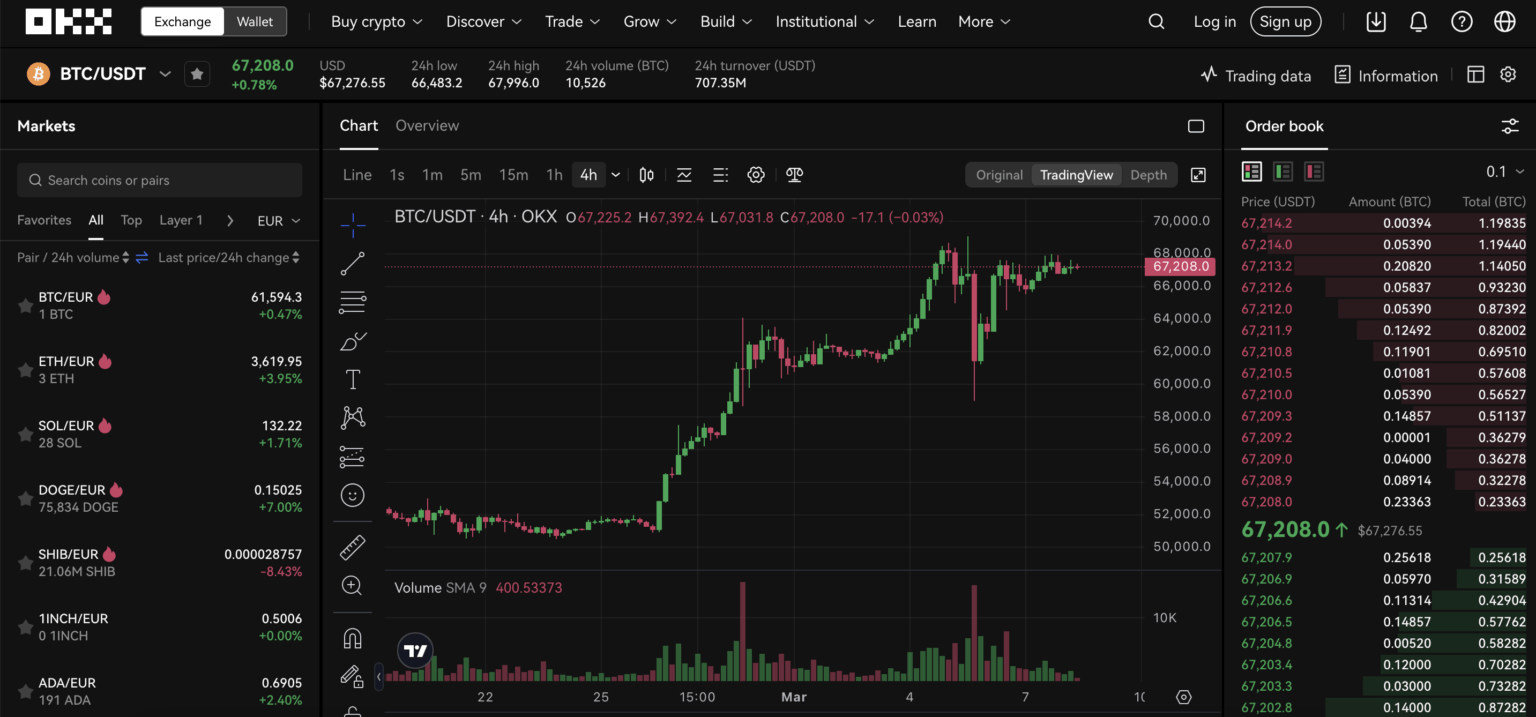
Screenshot of OKX web trading interface showing charting, order forms and wallet connectivity—illustrates where login and Web3 wallet controls appear in the UI

How OKX verification works in practice (mechanisms and consequences)

Mechanically, OKX uses a tiered identity verification process: initial account creation requires basic details; to lift withdrawal and higher-fee limits you must complete Know Your Customer (KYC) checks — a government-issued ID and a facial-recognition liveness step. For U.S. users this is not optional in most cases: AML laws make exchanges require identification before enabling the full suite of services. The immediate consequence is simple: unverified or partially verified accounts face caps on deposit/withdrawal sizes, restricted product access, and often inability to use margin or derivatives.

Why those steps matter beyond compliance: verification is the gate that lets the exchange map legal risk to product permissioning. Once verified, the account can access spot, margin up to platform limits, staking, and derivatives (subject to jurisdictional allowances). But verification also increases your exposure to platform-held custody. If you keep assets on OKX after KYC, your counterparty risk is concentrated: the exchange protects assets with cold storage and multi-signature approvals (OKX reports storing over 95% of assets offline), but custodial solutions carry different failure modes than self-custody.

In short: KYC unlocks capability but narrows the security model to whatever the exchange provides and enforces. The trade-off is access versus control.

OKX Web3: non-custodial wallet, DEX aggregator, and where login fits

OKX is not only a centralized exchange (CEX); it bundles a non-custodial Web3 wallet that you control via a seed phrase and integrates a DEX aggregator to source liquidity across chains. Practically this means you can trade two ways: log into the central account (custodial) or connect a self-custodial wallet (non-custodial) to interact with DApps and the DEX. The Web3 wallet supports hardware devices like Ledger and Trezor, which materially reduces the risk of remote key exfiltration compared with a hot wallet.

Operationally, the login and connection choices change both permissioning and risk profile. If you connect a Web3 wallet to OKX’s browser extension or mobile app, you retain private key control — no KYC required for on-chain swaps — but you also assume direct smart-contract and phishing risks. Conversely, a logged-in OKX user who stores funds on the exchange trades smart-contract risk for counterparty risk and the protections of cold storage and Proof of Reserves (OKX publishes on-chain PoR statements enabling users to verify backing ratios).

One practical rule: treat custody and verification as part of your trade plan. If you want rapid access to advanced derivatives and fiat rails from the U.S., KYC is unavoidable. If you want maximum control and to interact permissionlessly with DeFi, the non-custodial wallet is the right surface — but it requires disciplined key management.

Login security and friction: what the mechanisms mean for traders

OKX employs military-grade encryption, AI-driven threat detection, and mandatory two-factor authentication (2FA) for logins. These are meaningful defenses: 2FA reduces account-takeover risk substantially, and the AI systems can flag anomalous access that would otherwise go unnoticed. On mobile, biometric login speeds access while reducing reliance on SMS 2FA, which is vulnerable to SIM swap attacks prevalent in the U.S. market.

Yet no system is perfect. The limits are structural: phishing remains the most common vector that bypasses technical defenses because it exploits human trust. For Web3 interactions, permanent loss from mismanaged seed phrases is another hard boundary — there is no tech fix for a lost seed. For custody on the exchange, while cold storage and multi-signature withdrawals reduce the probability of a mass theft, they do not eliminate operational risk, governance errors, or legal seizure in adversarial scenarios.

Therefore, combine procedural controls (unique passwords, hardware 2FA, anti-phishing codes) with mental rules: never paste your seed phrase into a website, and treat any out-of-band request for your credentials as hostile. Those habits are as important as the exchange’s technical engineering.

What access to products looks like after verification

Once you complete verification on OKX, the platform often enables: spot and margin trading (with up to 10x margin in isolated or cross modes), derivatives including futures and options (leverage up to platform-specified caps like 125x for some perpetuals, depending on asset and jurisdiction), staking and yield-generation products (flexible and fixed-term staking plus DeFi yield farming and auto-compounding), and the NFT marketplace. The catch: some products are region-restricted by law or internal policy; U.S. traders may find certain derivatives or token listings limited compared with other jurisdictions.

Also note product risk differences. Staking and yield products offer passive income but expose you to validator slashing, lock-up periods, and counterparty risks when the staking is managed by the platform. Margin and derivatives amplify returns but also magnify losses and can trigger forced liquidations in volatile markets — a frequent practical hazard around low-liquidity tokens, which is why OKX periodically delists weak pairs (for example, recent delisting of several small spot pairs is part of routine liquidity maintenance).

Decision framework: choosing login mode for a trading objective

Here is a short heuristic I use with traders in the U.S. to choose a login/custody path:

– Liquidity and speed (day trading, quick fiat on/off ramps): prefer a verified custodial account. Expect stronger fiat rails, faster order execution, and access to margin/derivatives, but accept counterparty risk.

– Long-term custody of selective assets + DeFi interactions: favor the non-custodial OKX Web3 wallet or hardware wallet with the exchange as a gateway. You keep keys and reduce central failure points, but you trade convenience and on-exchange product breadth.

– Mixed strategy: use both — keep capital you actively trade in the custodial account and move reserve capital to a self-custodial wallet. This adds operational overhead but splits risk profiles.

Where the system breaks and what to watch next

Two boundary conditions matter. First, regulatory change. U.S. policy developments on stablecoins, KYC for on-chain transactions, or derivatives rules could change which products are available to U.S. users and how onerous verification becomes. Second, market liquidity. Exchanges routinely delist low-volume pairs to protect users from extreme spreads and poor execution; those maintenance choices change the available trading universe and can disrupt strategies built around niche tokens.

Signals to monitor: updates to OKX’s Proof of Reserves publication, any changes to KYC flows or liveness-check tech, and exchange announcements about delistings or product suspensions. These are reliable leading indicators of how usable the platform will be for a given strategy.

For a practical next step, traders should compare the exchange login path with the non-custodial flow before funding significant capital. If you want the official login entry point and step-by-step flow, the OKX web gateway is a useful reference: okx.

FAQ

Do U.S. users have to complete full KYC to trade on OKX?

Yes for most full-featured services. Basic account setup can be quick, but to raise withdrawal limits, use fiat on/off ramps, and access margin or derivatives you will be asked for government ID and a facial liveness check. Expect this to be the norm because of AML obligations.

Is the OKX Web3 wallet safer than keeping funds on the exchange?

“Safer” depends on the risk you worry most about. Self-custody removes counterparty and exchange insolvency risk, but it places the entire burden of key security on you; losing a seed phrase is permanent. Exchange custody centralizes security (cold storage, multisig) and operational protections, but increases exposure to platform-level failures. A hybrid approach balances both.

What login protections should I enable immediately?

Enable strong, unique passwords; hardware 2FA (or an authenticator app) rather than SMS where available; anti-phishing codes if the exchange offers them; and biometric locks on your mobile device. For Web3 wallets, use hardware wallets for large balances and never disclose your seed phrase.

How do delistings affect my trading strategy?

Delistings remove liquidity for certain pairs and can strand positions if you hold tokens that become hard to convert on-exchange. They are a liquidity-maintenance tool; monitor exchange announcements and avoid building core strategies around very low-volume tokens unless you accept exit risk.

Closing takeaway: how you log in to OKX is a strategic choice, not a mere convenience. Verification grants access and regulatory compliance but shifts your security model toward the exchange. The Web3 wallet preserves self-sovereignty but demands disciplined key management. Treat the login decision as part of portfolio design: match custody, verification, and product access to the liquidity needs and risk tolerances of your trading plan, and watch regulatory and liquidity signals that can change that calculus.

Categories
Uncategorized

Misplaced certainty: why yield farming, spot trading, and hardware wallets are not a single “set-and-forget” security stack

Many DeFi users start with a simple mental shortcut: yield farming is about returns, spot trading is about timing, and hardware wallets are the final word in security. That tidy division is the wrong model. In practice these activities interact at the level of key management, chain access, contract risk, and operational friction. Treating them separately explains short-term choices poorly and can create gaps that a bad actor or a simple mistake will exploit.

This article walks through how yield farming strategies and spot trading behaviors change the security posture you need, explains how multi-chain wallet design (custodial, seed-phrase, or MPC-based) shifts threat models, and contrasts trade-offs between convenience and hard guarantees. My goal: give you a reusable mental model to choose (and configure) a wallet, evaluate gas and transfer pathways, and place hardware wallets or cloud-based MPC options where they actually belong in an operational plan.

Bybit Wallet app icon; useful to discuss trade-offs between custodial cloud wallets, seed-phrase non-custodial wallets, and MPC keyless wallets

How yield farming and spot trading change what “secure” must mean

Mechanism first: yield farming typically involves locking assets into smart contracts—liquidity pools, vaults, or yield aggregators—that execute arbitrary contract code. Spot trading is often just on-chain swaps or off-chain order books linked to an exchange. The practical difference is that yield farming increases smart-contract exposure while spot trading increases the frequency and volume of transfers and the need for fast reconciliation with exchange balances.

Why this matters: if your wallet is optimized only for “cold” storage security (e.g., a hardware device kept offline), it’s great against key exfiltration but painful for frequent position rebalancing. Conversely, if you prioritize fast internal transfers and gas-less bridging into an exchange, you may accept custodial trade-offs that increase counterparty risk. The correct setup depends on behavioral profile: an active yield farmer needs quick DApp connectivity and sound smart-contract risk analysis; a spot trader values low-latency deposits/withdrawals and predictable settlement windows.

Wallet types mapped to use cases and trade-offs

Think of wallets as a three-way spectrum: custodial convenience, seed-phrase autonomy, and MPC-based hybrid. Each reduces some risks and amplifies others.

Custodial Cloud Wallet: highest convenience. Managed keys let you jump between exchange-led products, internal transfers typically avoid gas fees, and account recovery is handled by the provider. The obvious trade-off is custody: your counterparty—and their operational security and policies—now matter. For US-based users, custodial flows can also trigger KYC at withdrawal or for certain promotions; KYC is not required to create the wallet in many cases, but downstream processes may be.

Seed Phrase Wallet: maximum cryptographic sovereignty. You control the private key and can interact across devices and platforms. That control is real but brittle—loss or theft of the seed phrase is permanent. For active DeFi users this offers the strongest protection against centralized failure, but it demands disciplined backups, hardware signing for high-value moves, and a plan to rotate keys if exposures appear.

MPC Keyless Wallets: intermediate option with nuanced limits. Multi-Party Computation splits key material into shares (one held by a provider, one encrypted in your cloud). This reduces single-point-of-failure risk and enables passkey-style convenience and biometric logins. The catch: many MPC implementations currently have operational constraints—like mobile-only access or mandatory cloud backups for recovery—which affect threat models (cloud compromise vs. physical device theft). In practice, MPC is attractive for people who want non-custodial semantics without the full responsibility of seed-phrase management, but it is not identical to a hardware wallet’s threat model.

How by design features alter your operational choices

Several platform-level features change how these trade-offs play out in real life. For example, the ability to move assets between an exchange account and wallet without incurring on-chain gas alters liquidity management: you can keep dry powder on exchange rails for quick spot trades and fund DeFi positions from a wallet when you want to farm. That reduces gas costs and friction, but increases attack surface because exchange-side custody or account compromises can affect your Web3 activity.

A practical benefit for active users is instant gas conversion: gas station mechanisms that swap stablecoins into native gas token prevent failed transactions due to insufficient fees—a real nuisance during congested moments. Yet these conveniences also centralize dependency: if the gas-conversion service or routing fails, your ability to interact with time-sensitive contracts can be impaired.

Hardware wallets vs. MPC vs. cloud: where a hardware device still wins

Hardware wallets (true offline devices) offer a decisive advantage against remote key theft and malware that tries to exfiltrate private keys. For large, long-term holdings or vaults that sign expensive multisig transactions, hardware devices are still the most robust choice. The limitation is usability: they are slow for high-frequency trading and require integration layers (like Ledger/MetaMask combos) for many DApps, and cross-chain friction can compound.

MPC and cloud-backed key models improve usability and make mobile-first flows seamless, but they substitute different assumptions: distributed trust and secure cloud storage. If you rely on a cloud backup, evaluate cloud-provider security and the encryption model—if the cloud-held share can be obtained or decrypted, your protection degrades. So hardware retains unique value for high-assurance signing even as MPC matures.

For more information, visit bybit wallet.

Smart-contract risk: a security layer many users underweight

Yield farming’s primary technical risk is not always the wallet but the contract. Honeypots, owner privileges that can change tokenomics, and modifiable tax parameters are persistent issues. Wallets that integrate smart-contract risk scanning to flag these indicators give a measurable risk-reduction by forcing a pause in the user’s mental model: “Do I understand what this contract can do?”

But scanning tools are heuristics, not proofs. A flagged contract is a signal, not a verdict. The non-obvious takeaway: combine wallet-level warnings with your own minimal due diligence—reviewing token ownership status, pause functions, and whether a project has audited contracts. For DeFi allocations large relative to your total portfolio, assume the contract risk is the dominant variable and treat wallet choice as secondary for that specific exposure.

A practical wallet-decision framework for US multi-chain DeFi users

Here’s a simple decision heuristic you can reuse:

– Define your primary behavior: frequent spot trader, active yield farmer, or long-term holder. Each needs a different mix of speed vs. assurance.
– Map assets to custody tiers: small, frequent-use balance (hot or MPC); medium-sized active positions (seed phrase with hardware signing); large cold holdings (hardware, multisig).
– Layer protections: enable passkey/biometric, 2FA, anti-phishing codes, and withdrawal whitelists. Use provider features like mandatory delay on new addresses for high-value transfers.

If you want an integrated route that blends exchange rails and Web3 access, evaluate wallet options that support multiple chains, internal gas-free transfers to the exchange, and built-in risk scanning. A concrete example of this blended approach is available from services that offer custodial, seed-phrase, and keyless options under one roof—letting you place different assets into different custody buckets as your strategy demands. For an example of such a multi-option wallet that also supports many Layer 2s and has internal transfer conveniences, see the bybit wallet.

Where systems break and what to watch next

Three boundary conditions deserve attention. First, KYC friction: while wallet creation may not require native identity verification, certain rewards or withdrawals to exchanges can. That can surprise US users expecting full anonymity. Second, mobile-only MPC implementations create a single-device dependency—if you lose the phone and cloud access fails, recovery options vary by provider. Third, smart contract heuristics only flag common anti-patterns; novel exploit techniques can sidestep them.

Signals to monitor: adoption of cross-chain standards for safe approvals, wider hardware support for L2/rollup signing, and whether MPC vendors open up multi-device recovery flows without sacrificing security. These developments would materially change the usability-security frontier and are worth tracking if you rotate capital between spot and yield strategies frequently.

FAQ

Q: Should an active yield farmer use a hardware wallet?

A: Use-case dependent. For frequent rebalances a hardware wallet is operationally clumsy; however, for protocol interactions that control large pools or vaults, hardware signing (or a hardware-backed multisig) reduces catastrophic risk. A hybrid approach—MPC or custodial hot wallet for everyday activity, hardware-backed cold storage for treasury-level or long-term stakes—is often the pragmatic middle ground.

Q: Does mobile-only MPC mean I lose recovery options if I change phones?

A: Not necessarily, but check the recovery design. Many MPC implementations require a cloud backup and a device binder. That makes recovery possible but reliant on cloud access and provider workflows. If you prefer device-agnostic recovery, a seed-phrase wallet remains the most portable option, at the cost of personal key custody.

Q: Can I avoid gas fees entirely between my exchange and my wallet?

A: Internal transfers between exchange accounts and a paired wallet can avoid on-chain gas, depending on provider features. This reduces costs and speeds transfers, but it centralizes dependency on the exchange’s internal systems and custody model. Always weigh these operational savings against counterparty risk.

Q: How reliable are built-in smart-contract risk scanners?

A: Useful for triage but imperfect. They identify common red flags (honeypots, modifiable taxes, hidden owners) but cannot prove a contract is safe. Treat scanner results as one input in a layered due-diligence process: code review, audits, and economic modeling of the protocol are still necessary for large allocations.

Categories
Uncategorized

Myth: Bitcoin is anonymous — why CoinJoin matters and where it still fails

A common misconception among privacy-conscious users is that “Bitcoin is anonymous by default.” That idea is wrong in a practical, attackable way. On-chain transparency, pervasive blockchain analytics, and routine user mistakes create a set of predictable linkage channels that can deanonymize transactions. CoinJoin-style mixing is one practical countermeasure, but it is not a silver bullet: understanding how CoinJoin works, what it hides, and where operational discipline still matters is essential for anyone in the US who treats Bitcoin privacy as a core requirement.

This piece unpacks the mechanism behind CoinJoin, explains concrete trade-offs and failure modes, and describes operational rules of thumb you can use right away. It also situates CoinJoin within current tooling: how wallets implement it, what recent project changes mean for users, and which risks remain outside technical fixes.

Screenshot-style diagram of a privacy-focused Bitcoin desktop wallet showing CoinJoin controls, Tor status, and coin control UTXO selection

How CoinJoin actually breaks links — mechanism, not magic

CoinJoin is a pattern: multiple users’ unspent transaction outputs (UTXOs) are assembled into a single Bitcoin transaction whose outputs cannot be trivially matched back to the original inputs. The reason this works is simple arithmetic and ambiguity — if ten people each put in one input and receive ten indistinguishable outputs of the same denomination, an on-chain observer cannot determine which input maps to which output without external information.

Wasabi Wallet implements a specific, modern flavor of this idea called WabiSabi. It improves over naive CoinJoin by allowing variable-sized inputs and outputs while preserving participant anonymity sets through cryptographic commitments and credential-style mechanisms. Critically, Wasabi’s design is zero-trust: the coordinator that orchestrates rounds cannot steal coins nor mathematically link a given input to a given output. That architectural guarantee matters for custody risk.

Two practical parts of the mechanism that users must grasp: (1) Coin selection (UTXO-level management) shapes anonymity. The more granular and clean your UTXOs are before joining, the better the resulting anonymity set. (2) Network-layer protections matter: Tor routing hides who connected to the coordinator, closing a side channel that would let an observer pair an internet endpoint with on-chain activity.

What CoinJoin hides — and what it doesn’t

Where CoinJoin helps: it removes direct on-chain input-output linkage and enlarges the anonymity set when enough independent participants join. That greatly reduces the value of simple clustering heuristics that link addresses into single wallets.

Where CoinJoin does not reliably help: timing analysis, address reuse, mixed-coin spending, and metadata leaks from change outputs. For instance, if you mix coins and then immediately spend the mixed outputs back to known exchanges or to addresses previously linked to your identity, you reintroduce high-confidence links. Similarly, sending mixed and non-mixed funds together in one transaction creates a spend-pattern that often lets analysts infer which outputs are tainted.

Operational discipline is part of the privacy stack: do not reuse addresses, separate mixed and un-mixed coins until they reach a comfortable post-mix age, and avoid round numbers or obvious change outputs—Wasabi recommends small amount adjustments to prevent creating easily identifiable change UTXOs. These are not cosmetic rules; they disrupt core heuristics used by chain analysis companies.

Tooling, trust, and recent project context

Wasabi Wallet is an open-source, non-custodial desktop client that integrates CoinJoin, Tor, and advanced coin control. Users can connect it to their own Bitcoin node using BIP-158 block filters to avoid trusting third-party indexers, and it supports hardware wallets via HWI for custody workflows. However, hardware wallets cannot take part in CoinJoin rounds directly because the keys must be online to sign the active multi-party transaction.

Two recent project updates illustrate both progress and a continuing operational trade-off. Developers recently began a refactor of the CoinJoin Manager to a Mailbox Processor architecture, which is an internal design change intended to improve concurrency and robustness of round coordination. Separately, a pull request to warn users when no RPC endpoint is configured was opened — that small UI guard matters because running Wasabi without a trustworthy RPC endpoint increases your reliance on centralized backends and therefore your attack surface for privacy leaks.

One practical implication of mid-2024 coordinator changes: the official zkSNACKs coordinator was shut down. That means users must now run their own coordinator or connect to a third-party coordinator to participate in CoinJoin. Running your own coordinator raises operational complexity and node/availability responsibilities; using a third-party coordinator reintroduces an element of trust in network availability and operator behavior (even though the protocol is designed to be zero-trust against theft). Choosing between these options is a classic security vs. usability trade-off.

Decision-useful framework: three levels of privacy posture

To turn theory into action, think in terms of three operational postures rather than a binary “private/not private”:

1) Baseline hygiene — moderate privacy. Use Tor, avoid address reuse, enable coin control, and keep mixed and non-mixed funds separate. This level mitigates trivial deanonymization but will not resist determined analysts linking transactions through ancillary data.

2) Defensive privacy — active mixing. Use coordinated CoinJoin rounds via a reputable coordinator or your own, run a personal Bitcoin node (BIP-158 filters supported by the wallet), and use PSBT workflows for air-gapped signing when possible. This posture substantially increases the cost of deanonymization for many adversaries but requires more effort and makes real-time spending slower.

3) Maximum operational privacy — high discipline. In addition to the above, stagger spending timing, avoid exposing mixed outputs to custodial services, and accept the trade-offs: usability friction, need for technical maintenance (running a coordinator or node), and reduced compatibility with some hardware wallet workflows. This posture best resists intensive, resourceful observers—but even here, privacy is conditional, not absolute.

Limitations, unresolved risks, and what to watch next

No technical measure eliminates all privacy risk. Real-world deanonymization often comes from cross-layer correlation: exchange account KYC, IP logs, payment processors, or social metadata. CoinJoin reduces on-chain linkability but cannot erase external traces you or third parties create. Also, the effective anonymity set depends on how many independent participants use CoinJoin; if participation drops, each round’s privacy value falls.

Watch for two signals in particular: (a) coordinator decentralization and availability — if few coordinators or services dominate, a small set of operators becomes an availability and surveillance risk; (b) user tooling improvements that reduce error — features like clearer RPC warnings, better UX around coin separation, and stronger defaults against address reuse materially improve real-world privacy by lowering human error.

Finally, legal and regulatory signals in the US can affect privacy tooling indirectly: exchanges and custodial services tightening policies on mixed coins can create friction for users who rely on CoinJoin for legitimate privacy. That is not a technical limitation but an operational constraint that should shape planning.

FAQ

Is CoinJoin illegal in the United States?

Using CoinJoin itself is not inherently illegal. It is a privacy-enhancing technique. However, how you use mixed funds matters: if mixed coins are used to facilitate illicit activity, legal consequences can follow. In practice, regulatory and exchange policies sometimes treat mixed coins with suspicion; expect increased compliance checks, not automatic criminal liability for privacy-seeking users.

Can I use a hardware wallet and still CoinJoin?

Yes, but with caveats. Wasabi supports hardware wallets for custody and PSBT-based air-gapped signing, but hardware devices cannot participate directly in live CoinJoin rounds because signing for CoinJoin requires online interaction with the multiparticipant transaction. A common pattern is to move spendable coins onto a hot-wallet UTXO specially prepared for joining, then return mixed outputs to cold storage afterward.

Does running my own coordinator make me safer?

Running your own coordinator reduces reliance on third parties and can be safer from an operational trust perspective, but it increases maintenance burden and requires running networked services that can be attacked or misconfigured. For many users, connecting to a trusted third-party coordinator is an acceptable pragmatic choice if they accept the trade-offs.

How does Wasabi address network-level deanonymization?

Wasabi routes traffic through Tor by default, which masks the IP addresses of participants and helps prevent network observers from linking IPs to on-chain moves. That reduces a major side-channel, but Tor has its own threat model and operational considerations; combining Tor with careful timing and spend discipline gives stronger protection than any single measure alone.

Practical next steps for readers: if you want to explore CoinJoin with a well-known client, try the desktop wallet referenced above—wasabi wallet—but treat it as a tool within a broader operational plan: set up a node or verify RPC settings, learn coin control, and rehearse PSBT air-gapped flows before moving significant funds. Privacy is layered practice, not a single-click product.