
Here’s a statistic that should reset expectations: exchanges can hold over 95% of user assets in cold storage and still be vulnerable to user-side failures that cost traders just as much. In the case of OKX, high institutional security and broad product depth coexist with everyday risks—phishing, lost keys, poor order timing—that determine whether a trade is profitable or not. This article uses a realistic US-focused trading case to show how OKX’s spot trading fits into the practical decision set of a retail trader: how to sign in, how spot mechanics and platform features change trade outcomes, and where the system limits your choices.
To make this concrete, imagine Jess, an active US-based crypto trader who wants to move $10,000 from a US bank into BTC and a handful of altcoins on OKX, trade spot markets, and occasionally stake for yield. Jess’s decisions—how she logs in, what order types she uses, how she manages custody—will account for far more portfolio variation than whether OKX claims cold-storage or Proof of Reserves. The goal here is to convert platform features into tactical trade-offs you can use as a decision framework.
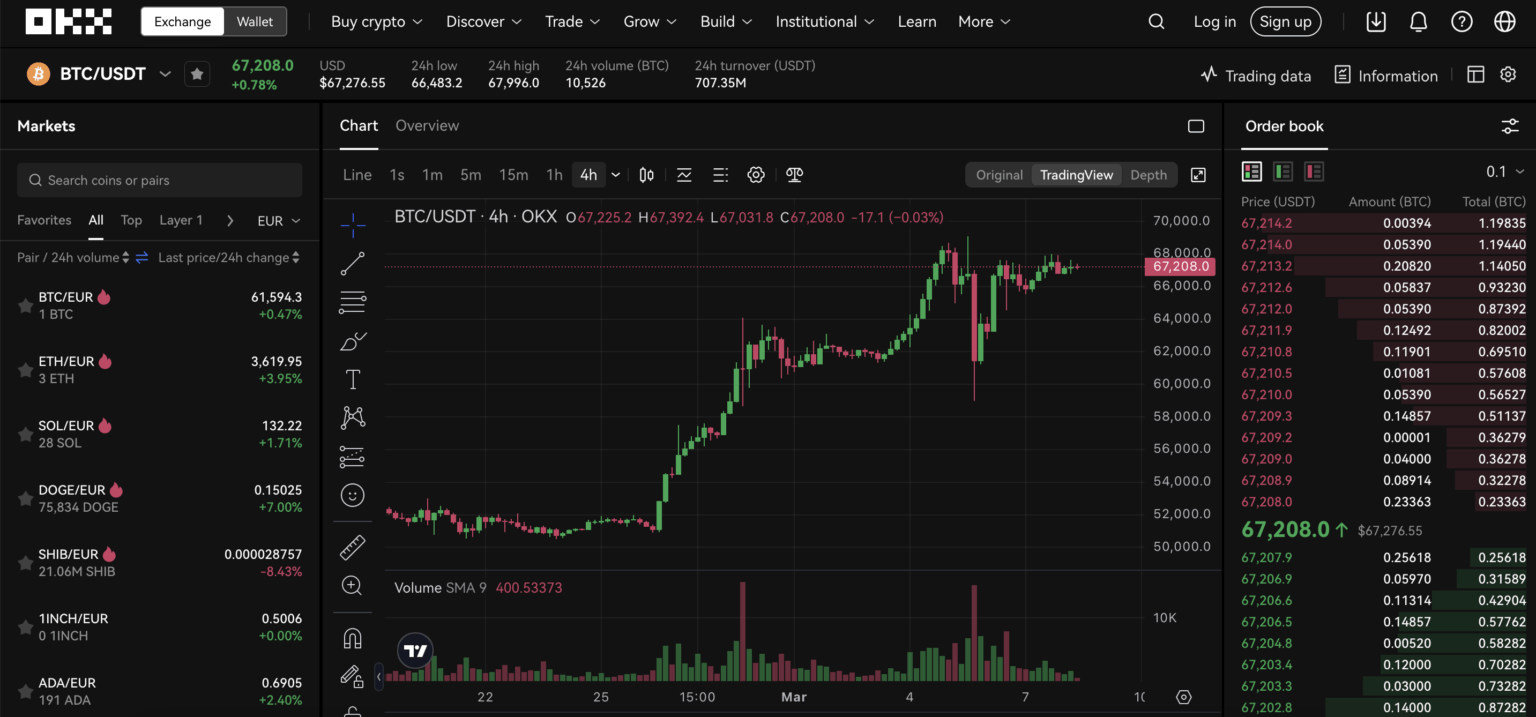
How OKX Spot Trading Works in Practice (Mechanics that matter)
Spot trading is straightforward in definition: buy or sell an asset for immediate settlement at the current market price. But the practical outcomes depend on three interacting mechanisms that traders frequently under-appreciate.
1) Order routing and liquidity: OKX supports over 300 assets and acts as both a primary centralized venue and a DEX aggregator. For popular pairs (BTC/USDT, ETH/USDT) liquidity is deep and slippage minimal; for niche tokens, OKX’s DEX aggregator may route trades across Uniswap or other pools to find better prices, which helps but doesn’t eliminate wide spreads. Mechanism takeaway: choose pairs with visible order-book depth if slippage matters for your ticket size.
2) Order type choice: market orders execute immediately but accept the current spread and any transient price movement; limit orders give price control but can miss fast moves. Using Good-Til-Cancel (GTC) or post-only options can save costs for liquidity providers but may leave orders unfilled. For Jess’s $10k entry into BTC, a staged limit ladder across the book may reduce execution cost versus a single market order—at the cost of execution certainty.
3) Settlement and transfer friction: deposits and withdrawals to OKX are mediated by supported chains—over 130 native blockchains are supported, plus Layer 2s like Arbitrum and Optimism. Each chain has different fees and confirmation times. If you plan cross-chain moves from a self-custodial wallet into OKX, you must pick a chain with good on-ramps and known withdrawal costs; otherwise the transfer fees and time will eat returns on small trades.
Login, Account Protection, and the First Line of Defense
Before you trade, log in safely. OKX enforces KYC and requires 2FA; the platform pairs military-grade encryption with AI-driven threat detection to flag suspicious logins. That reduces platform-side risk, but it does not replace good user hygiene. Use biometric login on mobile, prefer an authenticator app over SMS where possible, and integrate hardware wallets (Ledger/Trezor) if you plan non-custodial interactions.
If you’re creating an account or returning after a break, follow the official flow for OKX sign in and account verification. For a simple starting point and step-by-step tips on the web login flow, see this okx login which matches the web cross-platform experience.
Important boundary: Proof of Reserves provides on-chain transparency about assets held by OKX, but it doesn’t stop phishing or secure a seed phrase you store poorly. In other words, platform-backed custody is strong; user-side key management remains the weak link for many real losses.
Comparing Alternatives: When OKX Spot Fits—and When It Doesn’t
For US traders, think of three alternatives to using OKX spot exclusively: (A) on-chain DEXs (non-custodial), (B) US-based CEXs with narrow domestic focus, and (C) purely self-custodial trading using hardware wallets plus DEX aggregators. Each has trade-offs.
A (DEX/non-custodial): Best for maximum custody control and interacting with DeFi, but exposes you to smart-contract risk and potentially higher gas fees. B (US-focused CEX): Better fiat rails and sometimes firmer regulatory clarity—at the cost of fewer cross-chain features and possibly narrower token listings. C (self-custodial + aggregators): Great for privacy and custody, but operationally heavier—requires seed management and manual bridging. OKX sits between these: it combines centralized security and fiat rails with an integrated DEX aggregator and a non-custodial wallet option, which makes it versatile—but also means you must decide per action whether to custody on-platform or off-platform.
Where Spot Trading Breaks or Surprises Traders
Common failure modes are not platform-level but human-level amplified by platform mechanics. Fast markets cause slippage; low-liquidity pairs leave you holding tokens you can’t exit quickly; bridging mistakes can permanently lose funds if you choose the wrong chain. OKX mitigations matter—cold storage, PoR, multi-sig withdrawals, and KYC reduce some systemic risks—but they cannot protect you from selecting a margin position you cannot cover, or from falling for a convincing phishing page.
For more information, visit okx login.
Another realistic surprise: staking and yield features on OKX are attractive, but they can lock funds (fixed-term staking) or expose you to DeFi counterparty risk when auto-compounding into protocols. The trade-off is yield versus optionality. If you need fast spot liquidity for rebalancing, keep a buffer in liquid stablecoins rather than staking it all.
Decision Framework: A Simple Heuristic for Spot Trades on OKX
Use this three-step rule when deciding how to execute a spot trade on OKX:
1) Liquidity first: check the order-book depth for your ticket size; if your intended trade is >1% of 24h volume, split it. 2) Execution method: use limit orders when price control matters; use market only for small, time-sensitive entries. 3) Custody plan: assign each asset to on-platform custody (easy fiat/derivatives access) or non-custodial wallet (control + DApp access) before you move funds. This prevents last-minute mistakes and clarifies withdrawal timing and fees.
What To Watch Next (Signals, Not Forecasts)
Watch three signals that can materially change the trade calculus for US users: regulatory guidance from US agencies that affects fiat rails; network fee environments on major chains (ETH/Layer-2 throughput and gas price changes); and liquidity shifts in newly listed tokens. If OKX continues expanding mobile reach—its app is marketed as a “money app” and counts itself among major global users—expect easier fiat onramps but also more beginner accounts mixed into order books, which can widen spreads for certain new tokens.
Each signal changes the trade-off between custody convenience and execution cost. For example, cheaper Layer-2 fees make frequent rebalancing more viable; tightened regulation on offshores could favor US-based fiat rails and narrower token access.
Frequently asked questions
Is OKX safe to deposit USD and trade spot from the US?
Platform-level safety is strong: cold storage for most assets, proof-of-reserves transparency, and AI-driven login protection reduce platform risk. Safety also depends on KYC compliance and the payment rails you use. For your personal risk, follow multi-factor authentication, avoid reusing passwords, and treat links and emails with suspicion. Don’t conflate institutional safeguards with immunity from user-side mistakes.
Should I use market or limit orders for a $10,000 BTC purchase?
It depends on urgency and liquidity. For $10k into BTC on OKX’s deep BTC-USDT books, a single market order is usually fine, but a limit ladder (staggered limit orders around current price) can shave execution cost if you can tolerate execution uncertainty. For small-cap altcoins, prefer smaller-sized market tests or limit orders to avoid paying wide spreads.
Can I use OKX’s staking while still trading spot actively?
Yes, but read the staking terms. Flexible staking allows transfers out but may not have instant liquidity; fixed-term staking locks funds for set periods. If you rely on that capital for opportunistic spot trades, keep a liquid portion in stablecoins or an on-platform wallet separate from staked funds.
What’s the most common login mistake traders make?
Relying on SMS 2FA only and clicking login links in unsolicited emails. SMS can be intercepted; phishing pages can harvest credentials. Use authenticator apps, biometric mobile login, hardware wallets for self-custody, and validate URLs before entering details.
Final practical takeaway: OKX’s combination of deep spot markets, cross-chain reach, and integrated Web3 tools makes it a flexible choice, but the platform does not eliminate the core trade-offs of execution, custody, and timing. Turn product features into operational rules—check liquidity, decide custody up front, and choose order types aligned with your risk tolerance—and you’ll convert OKX’s breadth into reliable execution rather than accidental exposure.